Inhalt

Yusef Önkol
Consultant
Your partner for ERP and technology.
AI added value directly in the ERP system
Industrial production is undergoing a profound transformation. Rising energy and raw material costs, volatile supply chains, growing competitive pressure, and an acute shortage of skilled workers pose enormous challenges, especially for small and medium-sized enterprises. To remain competitive today, companies need efficiency, transparency, and data-driven decisions in real time.
This is precisely where artificial intelligence (AI) becomes a strategic game changer—not as a replacement for existing systems, but as an intelligent extension of modern ERP systems.
ERP & AI – AI as an effective add-on to existing ERP
AI in the ERP environment: Using data instead of just managing it
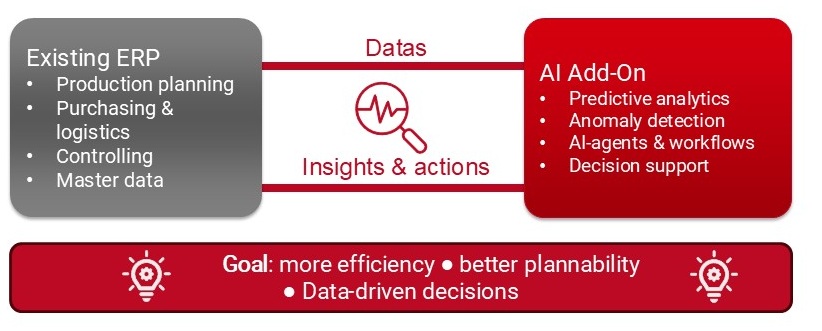
In many manufacturing companies, the ERP system forms the digital backbone for production planning, purchasing, logistics, finance, and controlling. However, traditional ERP solutions are primarily transaction-oriented: they store and structure data, but do not interpret it independently.
The targeted integration of AI technologies is creating a new level of value creation. AI analyzes large amounts of data, recognizes patterns, identifies deviations, and provides concrete recommendations for action. The result: predictive analytics, intelligent process automation, and sound decision support directly in day-to-day operations.
- Automated analysis of production and machine data
- Predictive maintenance to avoid unplanned downtime
- Demand and sales forecasts based on historical ERP data
- Anomaly detection in quality assurance and maintenance
- Real-time dashboards for management and production management
AI transforms isolated data points into strategically useful knowledge—thereby increasing productivity, planning reliability, and margins.
Intelligent workflows & AI agents: automation redefined
A key success factor for modern IT architectures is the intelligent orchestration of processes. Flexible automation platforms such as n8n enable ERP systems, machines, IoT sensors, databases, and external services to be seamlessly connected.
Event-based workflows ensure that processes are triggered automatically—without manual intervention or media discontinuity.
Building on this, AI agents come into play: autonomous, specialized software units that perform defined tasks independently, learn continuously, and act contextually.
Practical examples from industrial production:
– An AI agent monitors key production figures and reports deviations at an early stage
– A risk agent analyzes supplier data and assesses supply risks
– A reporting agent automatically creates management reports from ERP and production data
– A quality agent identifies patterns in reject rates
AI agents offer enormous leverage, especially for medium-sized companies with lean structures: 24/7 analysis, automated decision-making and reduced manual effort.
From data silo to knowledge management: the AI info consultant
The next evolutionary step is the intelligent use of company-wide knowledge. Production data, ERP information, documentation, maintenance manuals and empirical values often exist in isolation in different systems or departments.
This is where the AI Info Advisor comes in – an AI-supported knowledge instance that links structured and unstructured data sources.
The system connects:
- ERP data
- Production key figures
- Process documentation
- Quality reports
- Experience from specialist departments
Employees can ask the system natural language questions such as:
“Why did production come to a standstill last week?”
“What factors are currently influencing our reject rate?”
“Which suppliers currently pose the highest risk?”
The AI info advisor provides contextual, comprehensible and reliable answers in real time. This reduces dependencies on individual experts, accelerates decision-making processes and creates company-wide transparency.
AI as a strategic competitive advantage for industrial SMEs
Artificial intelligence is no longer a future scenario – it is an operational success factor. Companies that specifically integrate AI into their existing ERP landscape benefit from:
1. higher process efficiency
2. reduced downtimes
3. better resource planning
4. well-founded management decisions
5. scalable automation
The decisive success factor here is not isolated pilot projects, but a well thought-out, secure and economically viable integration into the existing IT architecture.
For IT-savvy production companies, this means that AI should not be seen as an experiment, but as a strategic add-on to the ERP system.
Our goal at MJR GmbH is to make AI tangible, integrable and economically viable – especially for medium-sized industrial companies. With modular add-ons, intelligent workflows, AI agents and innovative products such as the AI info consultant, we are shaping the digital future of production together. This turns data into real added value – and digitalization into a measurable competitive advantage.

Conctact us now
Michael Raber
General Manager