Inhalt

Julia Eberle
Marketing Manager
Your partner for ERP and Technologie
Cloud applications, remote work, hybrid IT infrastructures, and external service providers are changing the requirements for IT security. Traditional security approaches, which rely primarily on protecting the outer network boundaries, are increasingly reaching their limits.
This is precisely where the Zero Trust approach comes in. Instead of automatically assuming that users, devices, or applications within the corporate network are trustworthy, every access attempt is verified. Therefore, the fundamental principle is:„Never trust, always verify.“
What does Zero Trust?
Zero Trust does not mean that employees or business partners are fundamentally distrusted. Rather, trust in IT should not be assumed solely based on a specific network location.
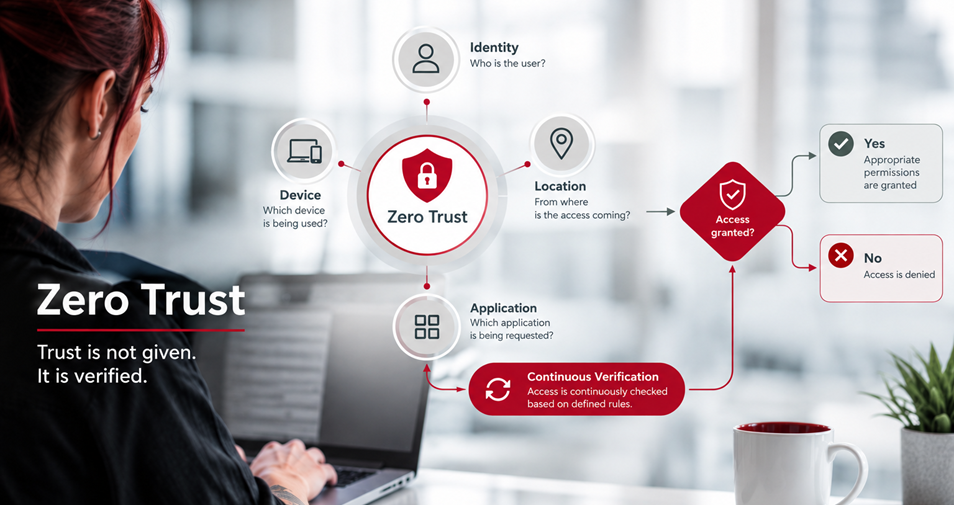
When granting access, for example, factors such as the user’s identity, the device being used, the location, and the requested application can be taken into account. Based on this information, a decision can be made as to whether access is granted and what permissions are actually required.
This transforms IT security into a dynamic process in which access requests are continuously evaluated according to defined rules.
Why traditional security approaches are no longer sufficient
Today, companies no longer operate exclusively within clearly defined networks. Employees access systems from home or while on the go, applications run in the cloud, and external partners need access to certain corporate resources.
As a result, the lines between “internal” and “external” are blurring. A user should therefore not automatically be granted extensive access rights simply because they are within the corporate network.
The Zero Trust approach addresses precisely this issue and considers not only the network connection but also the specific access to a resource.
The principle of least privilege
An important component of the Zero Trust model is the principle of least privilege. Under this principle, users are granted only the permissions they need to perform their specific tasks.
For example, a sales employee requires different access rights than an administrator. External service providers should also only be able to access the systems necessary for their specific tasks.
This can help reduce a company’s attack surface. If, for example, a user account is compromised, the potential scope of access is limited from the outset.
It is also important to review permissions regularly. Employees change roles or departments, projects come to an end, and new applications are added. Security policies must therefore evolve alongside business processes.
Identity as a key security factor
Identity plays a crucial role in the Zero Trust model. Modern authentication methods, such as multi-factor authentication (MFA), can serve as an important foundation for this.
In addition, information about the device being used, the location, or unusual access patterns can be taken into account. This results in a security approach that responds more effectively to the actual context of an access attempt.
Zero Trust is no single product
Zero Trust is not a single software solution, but rather a holistic approach to modern IT security. Depending on the infrastructure, elements such as identity and access management, MFA, device security, network segmentation, and monitoring may play a role.
Companies do not necessarily have to completely rebuild their IT landscape to do this. A Zero Trust approach can be implemented in stages—starting with an analysis of existing systems, users, applications, and permissions.
How MJR can help companies with Zero Trust
As a digital transformation partner, we at MJR help companies systematically develop their IT infrastructure while ensuring that security requirements align with existing systems and business processes.
Together, we can review existing access structures, applications, and processes to identify opportunities for optimization. Our focus is not on implementing a single technology, but on finding a solution that fits the company’s specific IT environment and requirements.
So what can we learn from this? Rethink your IT Security
The Zero Trust approach represents a shift in perspective in IT security: Trust is not automatically assumed; instead, every access attempt is specifically verified.
Especially in modern IT environments with cloud applications, mobile work, and external access channels, Zero Trust can help control permissions more precisely while reducing security risks.
Zero Trust is not a one-time IT project, but rather an ongoing process. Companies that regularly review their identities, permissions, and access create an important foundation for a modern and future-proof IT security strategy.

Get in touch with us
Michael Raber
General Manager